rCF Biz Overview

Selected Activities

  • The 16th Annual Meeting, Japan Society for Composite Materials
  • International Conference on Composite Materials (ICCM)
  • Japan Society of Civil Engineers (JSCE) Annual Meeting
  • Symposium, Japan Society for Composite Materials
  • Architecture & Civil Engineering Symposium

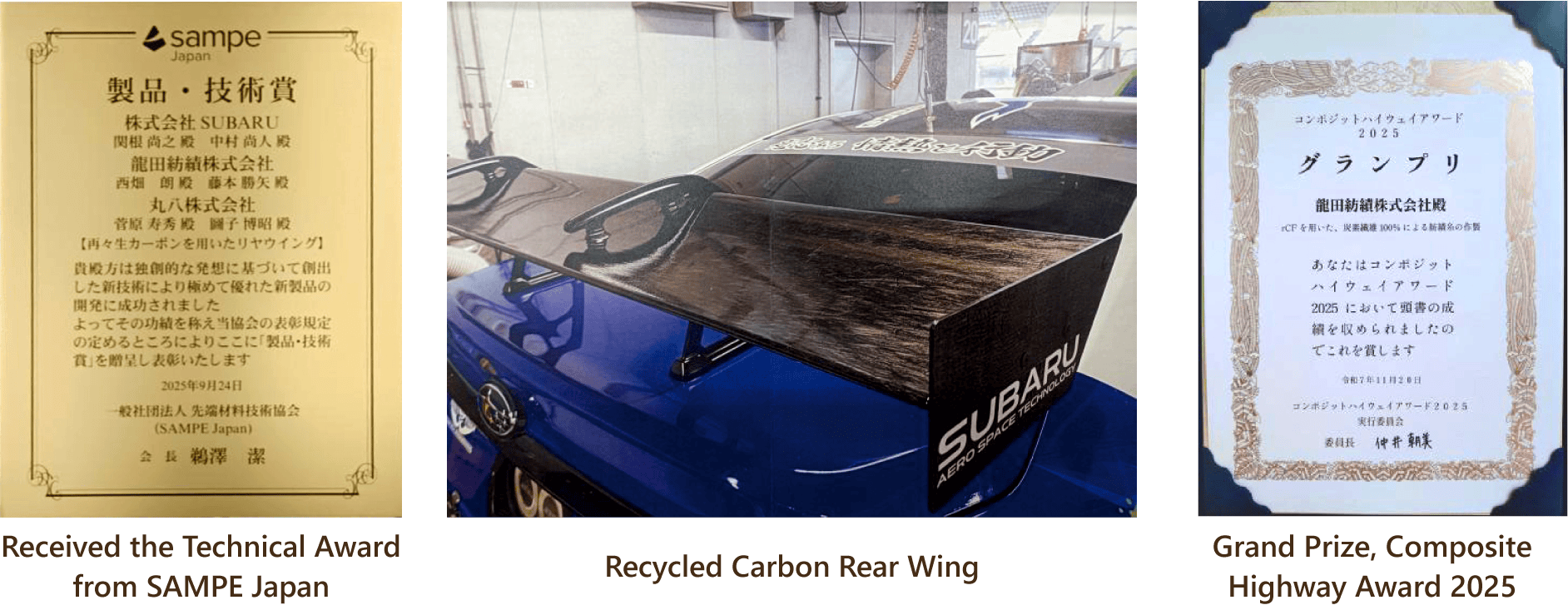
Selected Awards

  • SAMPE Japan Symposium
  • FRP CON-EX
  • Composite Highway Award 2025
Activity and Awards

Manufacture of Spun Yarn
from Recycled Carbon Fibers

1. TATSUTA's Vision for the Circular Economy

TATSUTA Spinning offers a new approach to the circular economy for carbon fiber.
Recycled carbon fiber (rCF) is recovered from end-of-life vehicles, aircraft, and other products. Conventional recycling methods mill recycled carbon fiber into fine powder.
However, once carbon fiber loses its length, its reinforcing effectiveness in composite materials is significantly reduced. Moreover, when fibers become too short, they cannot be recycled into high-performance materials again.
With our proprietary spinning technology, recycled carbon fiber can be reused repeatedly in a sufficiently long form. This enables true circulation of carbon fiber while maintaining high material performance.

CIRCULAR ECONOMY

Have you ever heard of the circular economy?
It is an economic system based on minimizing waste and continuously utilizing resources by keeping materials in use for as long as possible. Instead of the traditional “produce-use-dispose” model, resources are recovered, regenerated, and reused to create sustainable value.

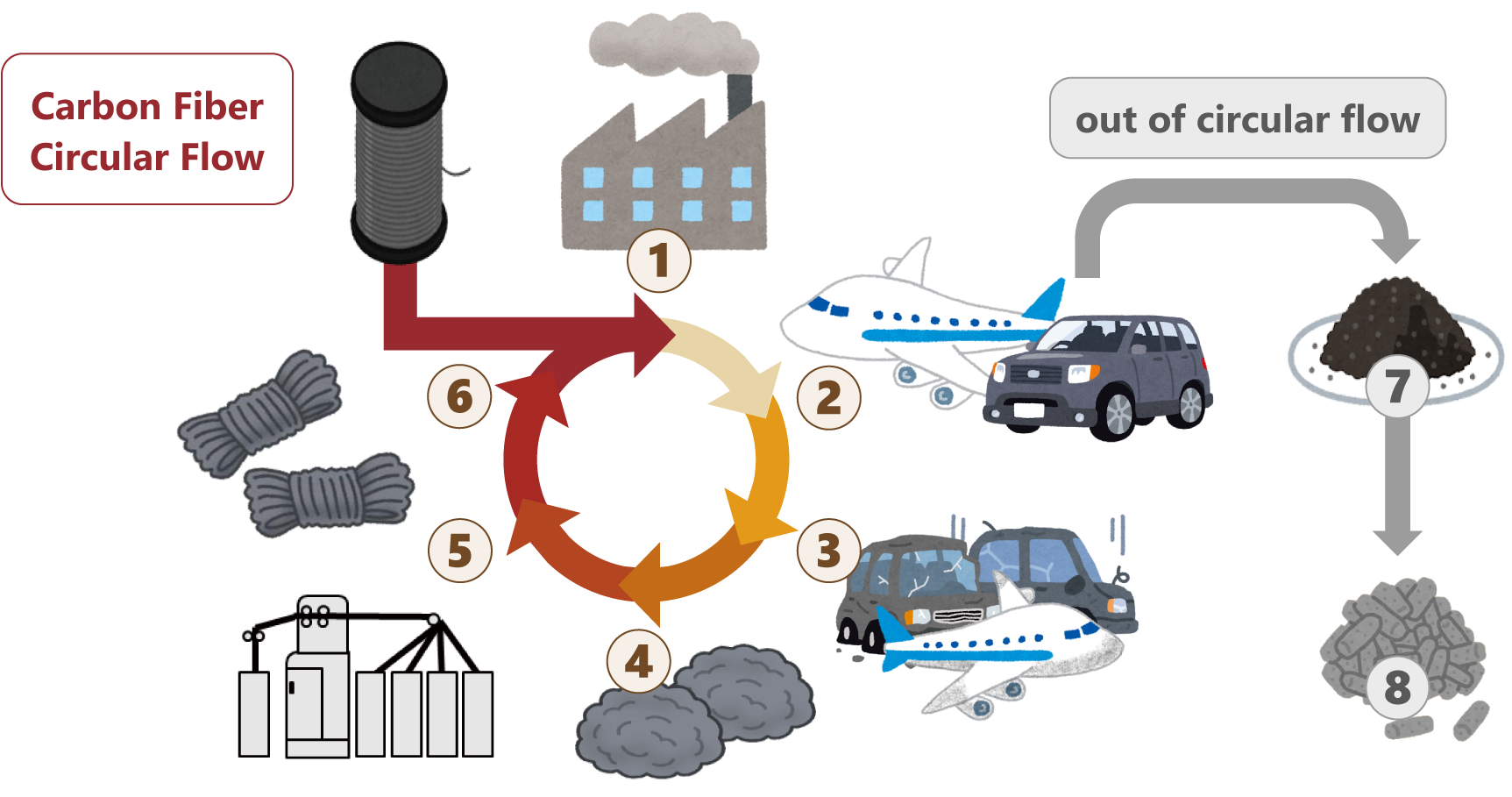
Carbon Fiber Circular Flow Diagram
CARBON FIBER CIRCULAR FLOW ①〜⑥
  • ① Virgin carbon fiber is used to manufacture new products.
  • ② Carbon fiber products are put into use.
  • ③ Products reach the end of their life.
  • ④ Carbon fiber is recovered from these products.
  • ⑤ The recovered carbon fiber is processed by our spinning machine to produce continuous rCF.
  • ⑥ rCF sliver is created, which can be applied in various products.

2. TATSUTA Spinning Products

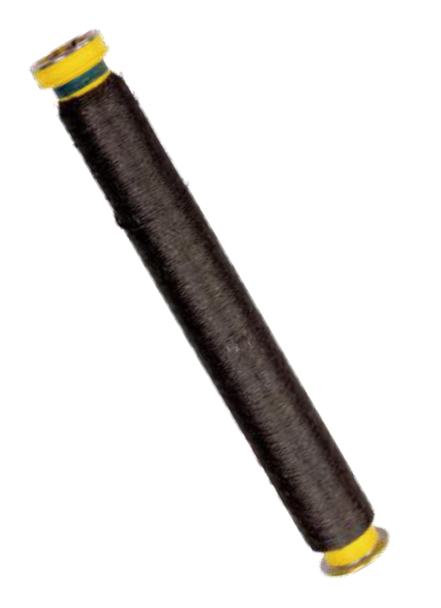
100% rCF Roving

100% rCF Roving

Roving made with carbon fiber has been produced before. However, roving made entirely from carbon fiber had not been achieved.
Producing roving with a high carbon fiber content is difficult. Carbon fiber has no crimp and, unlike cotton used in conventional spinning, does not easily entangle with other fibers. For this reason, roving has generally been produced by blending in crimped synthetic fibers.
TATSUTA Spinning has succeeded in producing roving made from 100% carbon fiber, without any additional materials.

Processed Products Using Roving (1)
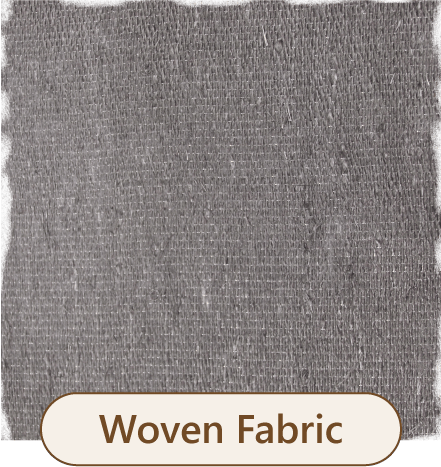
Plain Weave

Plain weave fabric can be produced using carbon fiber roving.
Plain weave is a basic weaving structure in which warp (lengthwise) and weft (crosswise) yarns cross alternately in an over-and-under pattern.

Woven Fabric
Processed Products Using Roving (2)
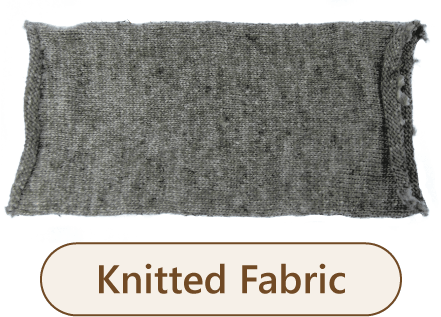
Knitted Fabric

Carbon fiber roving can also be used to produce knitted fabrics.
Carbon fiber in filament form is too stiff to be knitted, but when it is made into roving, it becomes soft enough for knitting.

Knitted Fabric
Processed Products Using Roving (3)
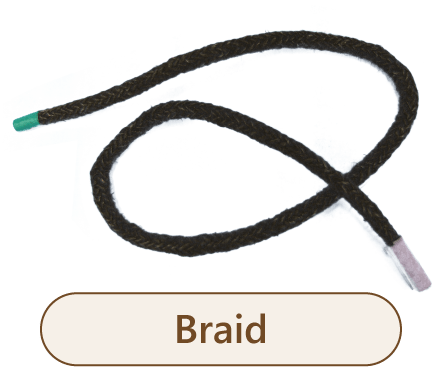
Braided Cord

It can also be processed into braided cord.
Braiding is a structure created by intertwining three or more yarns diagonally to form a tubular shape.

Braid
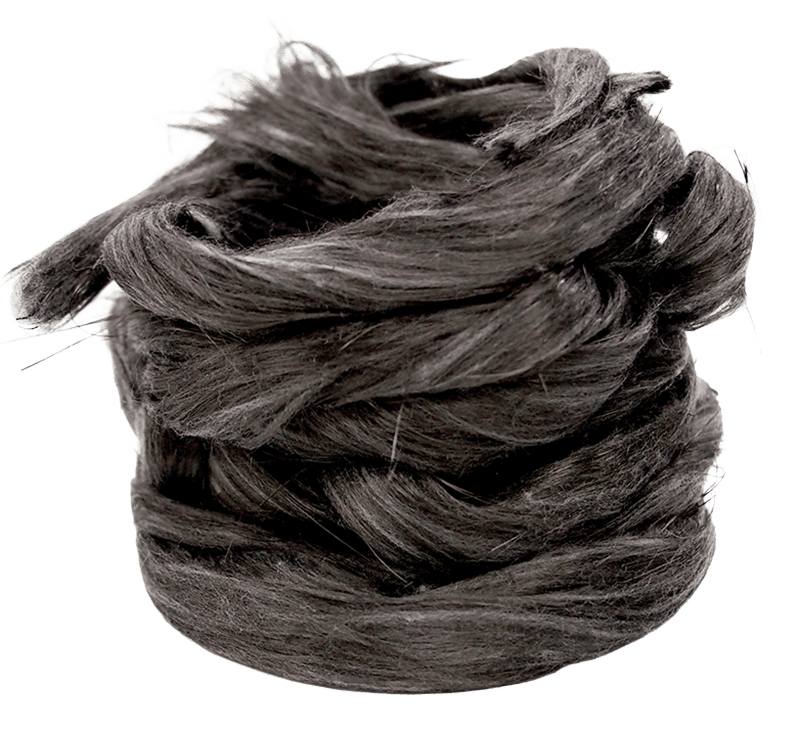
Sliver

Product Other Than Roving: Sliver

Sliver is the material stage before roving.
Carbon fibers, either used alone or blended with synthetic fibers, are evenly mixed and aligned in one direction. The fibers are not tightly bound and remain in a soft, fluffy state. For this reason, sliver is considered to have good resin impregnation.

Processed Products Using Sliver
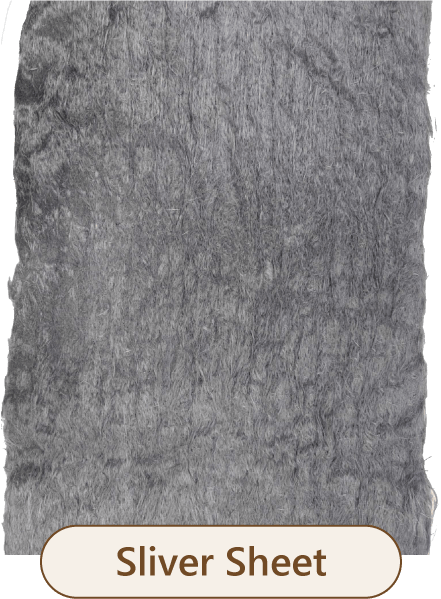
Sliver Sheet

Sliver has good resin impregnation.
However, during press molding, the fibers may flow out together with the resin when pressure is applied. To address this issue, needle punching is used to fix the sliver into a thin nonwoven sheet.
The backing material of the sliver sheet can be changed according to the application, such as to a resin mat or a glass mat.

Sliver Sheet

3. TATSUTA Spinning Technology

1. Opening and mixing process
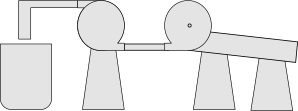
Machine Diagram: Opening and Mixing

Carbon fibers with a length of approximately 50mm are opened and mixed with thermoplastic resin fibers of the same length (e.g., PA6, PA66, PP, PET).
The fiber mixing ratio can be adjusted according to customer requirements. This process can also be applied to carbon fibers alone, without thermoplastic resin fibers.
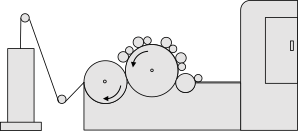
2. Carding process

Machine Diagram: Carding

The fibers prepared in step 1 are processed using a carding machine to separate fiber bundles, promote fiber alignment, and form them into a continuous fiber assembly.
The fibers are oriented predomnantly in the longitudinal direction and collected into string like bundles referred to as slivers.

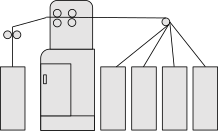
3. Drawing process

Machine Diagram: Drawing

Multiple slivers produced in the carding process are combined and drawn using a drawing machine.
This process improves fiber straightness, enhances alignment, and reduces thickness irregularities, resulting in a more uniform drawn sliver.

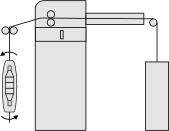
4. Roving process

Machine Diagram: Roving

The drawn sliver is further attenuated using a roving frame, then lightly twisted to provide cohesion.
The twisted fiber bundle is subsequently wound onto a bobbin as roving.

CONTACT US